


 Ukrainian
 Russian


There are no reviews yet.
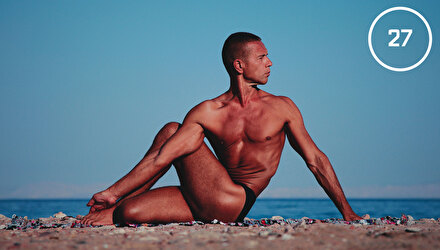
Practice with kapalabhati, lotus series and nadi shodhana
An 81-minute practice at a calm pace: short commands and counting to the breath, little explanation. Stretching, forward bends and breathing techniques outweigh strength work, and most of the main work is done in lotus. It loads the hips, knees, feet, lower back, spine, shoulder girdle and neck; the second half is a full pranayama and seated stillness.
What to expect in this class:
- Kapalabhati and setup (0–14 min): Sampurna mudra, 216 kapalabhati in two sets of 108 with three breaths in between, a move into jnana mudra, 24 eye circles each way. Then five rounds of sitali and kaki mudra with a swallowed breath, khechari mudra, simha mudra, mula and uddiyana bandha.
- Bends, bridge and push-ups (14–23 min): A long paschimottanasana holding the feet with six bends, butterfly with a forward bend, a wide-leg seated bend, halasana, chakrasana and a jump into vajrasana. Then a bridge resting on the crown with five push-ups out of it; the number of repetitions can be reduced.
- Lotus series (23–54 min): A full series of four elements: a twisting bend catching the toes from behind, a side bend with the elbow on the floor, yoga mudra with a backbend and padma niralamba sarpasana on the belly. The series is repeated in mirrored lotus, followed by one more block with the hands bound behind the back. Protect the knees and skip lotus if needed.
- Nadi shodhana and stillness (54–81 min): Three breaths, then four full cycles of nadi shodhana starting alternately with chandra bhedana and surya bhedana, followed by anuloma viloma and ujjayi with eye movements. After that a long stillness in jnana mudra and sampurna mudra at the end.
This practice is designed for experienced practitioners: demanding elements can be simplified or replaced with easier variations, and you can come out of inversions and holds earlier.


The review has been accepted and will be published after moderation.