


 Ukrainian
 Russian


There are no reviews yet.
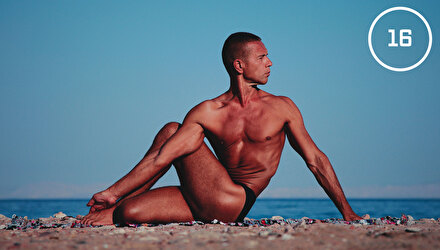
Morning practice with forearm stand, bridge and standing balances
A morning practice of 77 minutes at a calm, occasionally medium pace: more stretching, backbends and balance than strength. The main load falls on the spine, neck, shoulder girdle, hips and ankles, and in the forearm stand and handstand the shoulders, arms and abdominals work. The teacher speaks only now and then: explanations about attention and asymmetry, otherwise practice with short cues and wave-like transitions.
What to expect in this class:
- Setup (0–10 min): About six minutes of quiet sitting with the eyes closed, then a smooth stretch forward, a chin stand with the legs switched and a supine bridge with the shins held from the inside and the legs brought together; slow pace with holds.
- Backbends and inversions (10–21 min): Pressing up from the bridge with straight arms into a backbend, plough with the knees by the ears, a roll over the head, then a handstand with bent legs: the torso is carried forward between the arms with the legs as a counterweight. A squat follows.
- Rest and asymmetrical positions (21–43 min): About five minutes of Shavasana, then seated positions with a foot hold and a twist, first on the easier side and then on the weaker one, with lotus in between; midway the teacher talks about asymmetry and attention.
- Hips, inversions and finale (43–77 min): A wide seated stretch and Baddha Konasana, Shirshasana and a forearm stand with the legs switched, Shavasana; standing balances with a foot hold and folds, then push-ups from the bridge, a deep forward fold and sitting to the end.
This class is designed for experienced practitioners: the full lotus is needed for the "pure" version, but the more demanding poses can be replaced with simpler ones — half lotus or virasana.


The review has been accepted and will be published after moderation.