4 sequences of 24 to 35 minutes: core and ball, folds and hips, twists, one-leg balance
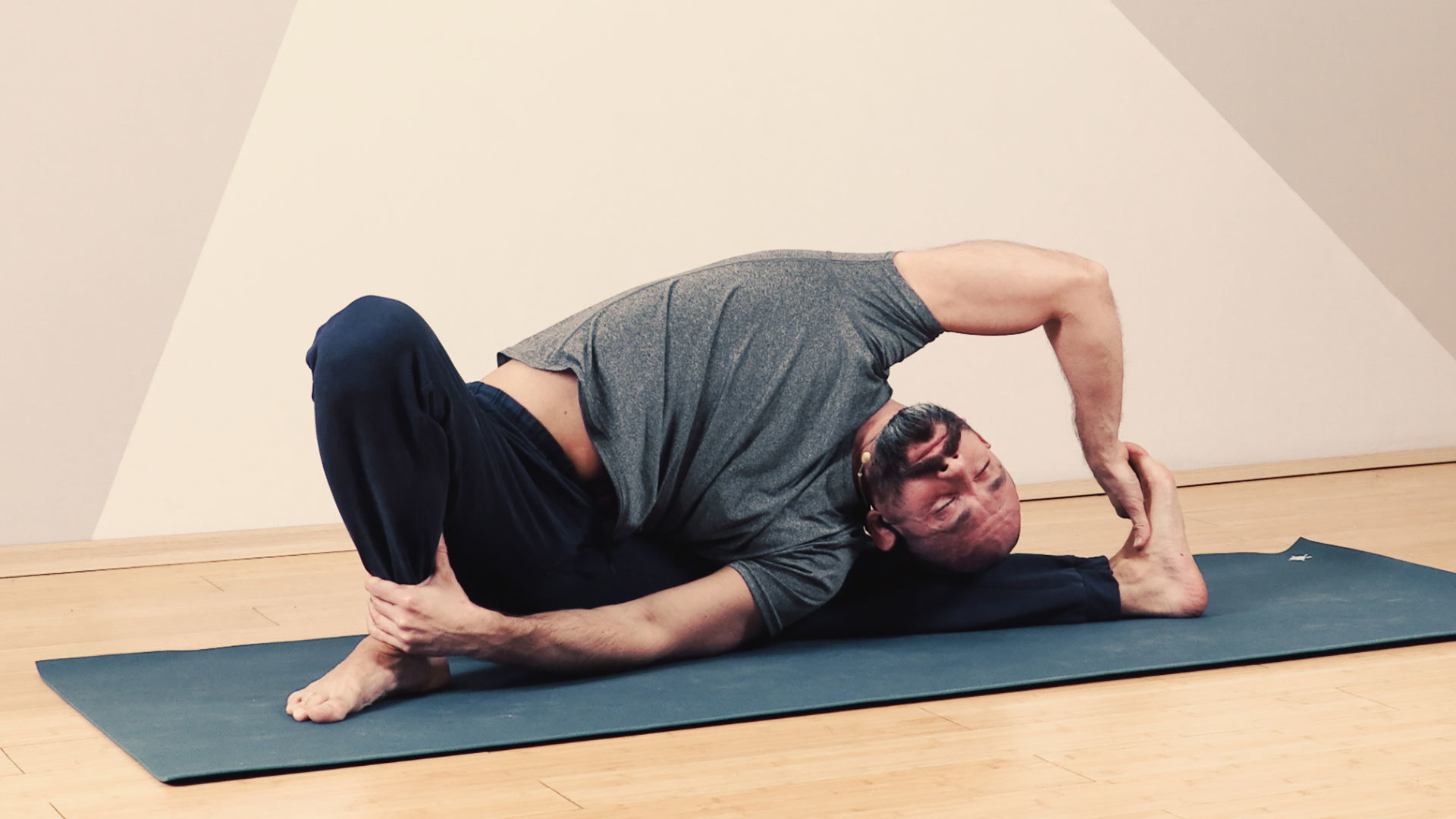
Series №2 is four stand-alone sequences with Pavel Makarin totalling about 112 minutes (35, 26, 24 and 26.5 min). It works like a construction set: each sequence has its own emphasis and structure, so you can practise them one at a time, choosing by goal and available time, or run them back to back. The practice is adaptive in that many exercises come with easier or deeper options (for example Bakasana instead of a harder arm balance, a half bridge instead of the full bridge, a shin over the thigh in place of lotus). The pace is calm to moderate, with holds of a few breaths, counted repetitions and detailed explanations; the load is moderate and above, a mix of strength work, mobility and stretching. Equipment: a mat, plus a small ball for the first sequence.
What to expect in this sequence:
Sequence 1: core, backbends and the ball, 35 min: Starts seated in Virasana with Kapalabhati (30 to 60 seconds) and Uddiyana bandha with a breath hold on the exhale, in three rounds. Then a backbend and rounding of the spine on all fours, shoulder rotations lying on the belly, grips of the shin and the opposite leg, a plank with the knee drawn alternately to the forehead, and a second Kapalabhati. Next a wrist lock behind the back with leg lifts and torso lifts lying on the belly, about 16 repetitions. Three times (about 2 minutes each) the belly is massaged with the ball from the solar plexus down to the navel; in between come a side stretch and 40 leg lifts lying on the side, Halasana and a hands-and-feet support with the legs hanging and their position changed 10 times. At the end a stretch of the front of the belly, Adho Mukha Svanasana, Uttanasana, Bakasana with a leg-over-shin variation and a short Savasana of about 2 minutes. The load falls on the abdominal and side muscles, shoulders and wrists; if it is too much, there is a version with the feet on the floor.
Sequence 2: folds, hips and backbends, 26 min: Starts seated in Virasana with breath ventilation of the lungs. Then Adho Mukha Svanasana, a roll into an upper inclined support and a lunge with a backbend (knee on the floor, straight leg, elbows back), a move into Janu Shirshasana and a fold with a straight back. This chain is repeated on the second side. Next the legs in half lotus (or a shin over the thigh) in a fold, the shoulder under the back of the head, a backbend lying down with the hands under the back moved higher towards the shoulder blades, knees pulled to the chest and legs over the head. Then the second side mirrored, Halasana, rolls on the back, a bridge supported on the hands (a half bridge as the easier option) and Paschimottanasana. It finishes with Savasana for 3 to 7 minutes. Focus: stretching the hips and backs of the legs, spine mobility; a calm pace with holds, lotus and bridge offered with easier alternatives.
Sequence 3: standing work, twists and strength mobility, 24 min: Starts standing with a hand lock and a backbend, then Utkatasana, a backbend with the palms on the lower back and folds with the torso parallel to the floor, twists with the elbow over the knee and Uttanasana with Uddiyana bandha. Next, in a dynamic mode, squats with the arms forward, rising onto the toes, Prasarita Padottanasana with rolls left and right, Mula bandha, a twist gripping the shin and turns of the shoulder girdle. After that Bakasana, a wave through the body on all fours, a backbend lying on the belly with the legs lifted and the feet moving, then a seated fold, a grip from behind the back, a support with push-ups and seated Kapalabhati. Savasana is optional (2 to 5 minutes). The load: legs, hips, shoulders and arms, obliques; the pace is moderate with a lot of dynamic work.
Sequence 4: one-leg balance, hips and inverted poses, 26.5 min: Starts standing: a leg pulled in, then Virabhadrasana with the torso parallel to the floor, Vrikshasana with the heel at the perineum and a variation with the shin over the thigh and a fold. Then the second leg, lunges, a support with the straight leg lifted off the floor (without lifting as the easier option), seated twists (Ardha Matsyendrasana) and a hands support with a leg in the air. Next Halasana and a shoulder stand with core work (if it is hard, the hands under the lower back and the elbows closer), a half lotus lying down and a grip with the shoulder behind the head, pulling the heels towards the forehead, Kapalabhati lying down and Savasana for 2 to 5 minutes. Focus: balance, hips, core, shoulder and neck mobility; care is needed in positions that load the neck.
The first sequence is the longest and the only one with a ball (a tennis ball will do); the other three are done on the mat alone. The sequences can be combined, and the harder exercises have easier options.
Акцент на вентиляцию легких и мобильность позвоночника. Включает Капалабхати, волны по телу, работу в Бакасане и глубокие наклоны для освобождения от напряжения.
Динамичная практика с перекатами, акцентом на раскрытие грудного отдела и силовые упоры. Завершается мягкой Пашчимоттанасаной и глубокой Шавасаной для восстановления.
Утренняя последовательность: от Уткатасаны и прогибов до силовых отжиманий. Особое дыхание сквозь зубы поможет сохранить бодрость и фокус без лишнего расслабления.
Сбалансированная тренировка с акцентом на балансы на одной ноге и элементы лотоса. Завершается перевернутыми асанами и техникой «обнуления» в финальной Шавасане.



 Ukrainian
 Russian
 View files


 A series of sequences
 4 flows, 20–30 min each
 Medium, High, Useful for everyone
 For a full body workout

 Download for the PC
 Download for the phone


 Sequence
 Sequence
 Sequence
 Sequence
The review has been accepted and will be published after moderation.