

 Ukrainian
 russian
An eight-hour day at the computer sooner or later shows up as a stiff neck, an aching lower back and a heavy head. This article gives you a 15-minute routine and a few micro-breaks for your working day. They are drawn from the courses of Yoga Masters teachers Andrii Siderski, Vyacheslav Gutsalyuk, Olena Popovich and Eduard Malakhov.
What “computer syndrome” is
Andrii Siderski describes it as a whole set of problems that build up gradually:
- slouched posture and a “computer neck” pushed forward;
- pain in the back and lower back;
- numbness in the arms and legs;
- blurred vision, headaches, quick fatigue.
It shows up differently in different people, but the mechanics are the same. The spine stays in one position for hours, the small muscles around it weaken, and the neck and shoulders hold the head in an awkward position.
Eduard Malakhov adds one more cause. People have always sat, but not under a constant stream of information. When the brain works all day and jumps at every notification, the body lives in tension too. So the tiredness after an office day is not only about your back, it is also about your head.
Why a quick stretch is not enough
The usual response to a stiff back is a stretch or a couple of forward bends. It feels better for an hour, and by evening it is back. Yoga Masters teachers approach the back differently, and five principles run through their courses.
- The spine needs movement in every direction. Vyacheslav Gutsalyuk builds his sequences on the principle of compensation: a forward bend is balanced by a backbend, left by right, and twists are added. Forward bends alone just repeat the slouched position you sit in all day.
- Strengthen, not just stretch. The small muscles along the spine form a natural corset. If it is weak, no amount of stretching will keep your back straight. Good news from Siderski: shaking muscles in a strength exercise are not weakness but a “working tremor”, a sign that the load is right.
- Simple exercises and easier options. Siderski’s routine for computer workers uses only basic exercises. If something is too hard, bend your knees, keep a foot on the floor, reduce the range. “It will still work,” he says.
- Breathing and stillness after the exercises. After each short sequence, Siderski suggests sitting with a straight back, taking a few calm breaths and staying in silence for a while. In his words, these pauses let the body “absorb” the effect and release the overload from the head.
- Regularity matters more than length. One session is not enough. Siderski recommends doing his routine 2–3 times a week for 3–4 weeks. Gutsalyuk says that after 1–3 months of regular practice the tissues begin to adapt, and advises changing sequences from time to time: the body gets used to the same load.

A 15-minute routine
This is a simplified selection from our teachers’ courses for beginners. Do it in the evening after work or in the morning on a mat or carpet. Two rules throughout: move with your breath and don’t hold it; if you feel sharp pain, reduce the range or skip the exercise.
- Seated warm-up, 2 min (from Eduard Malakhov’s routine). Interlace your fingers. Slowly turn your head left and right, 3 times each way. Roll your shoulders 6 times forward and 6 times back. Rub your palms until warm and rub your lower back with them.
- “Cat”, 3 min (from Olena Popovich’s course). Come onto all fours: palms under shoulders, knees under hips. Push the floor away with your hands, don’t sink into your shoulders. Inhale into a backbend, crown reaching forward; exhale into a rounded back, shoulder blades up. Let the movement travel as a wave from tailbone to neck, 6 rounds. Then extend your right leg back and left arm forward for 3 breaths, and on an exhale draw the knee toward your forehead. 3 times on each side.
- Squat, 1 min (from Andrii Siderski’s routine). Lower into a deep squat, feet flat on the floor, arms forward, torso upright. Stay for 5 breaths. If your heels lift, hold on to a support or put a folded towel under them.
- Lying backbend, 2 min (from Siderski’s and Popovich’s courses). Lie on your stomach, legs hip-width apart, palms under your forehead. Lift one straight leg, toes reaching back, and breathe freely for 5 breaths. Then the other leg. If it’s easy, lift both legs together. Keep your neck in line with your spine, don’t throw your head back.
- “Crocodile” lying twists, 3 min (from Olena Popovich’s course). Lie on your back, arms out to the sides, feet near your hips and hip-width apart. Rhythmically lower your knees to one side and turn your head to the other, “one-two”, 10 times. The goal is not to touch the floor with your knees but to keep your shoulders down. After the set, straighten your legs, relax and breathe into your belly. Repeat once more with your feet together.
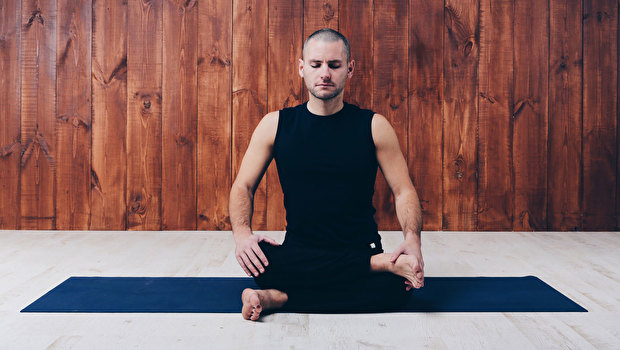
- Seated forward bend, 2 min (from Siderski’s routine). Sit with your legs forward, knees bent as much as you need. Hold your knees from the sides and first lengthen upward. Then round your back and draw your head toward your knees for 6 breaths.
- Pause, 2 min (following Siderski). Sit comfortably with a straight back, hands on your knees. Take 9 calm breaths, then simply sit still for a minute and let your thoughts settle. If you have time, lie on your back in shavasana for another 5 minutes.
Do this routine 2–3 times a week for at least a month. Once it feels familiar, it’s time to move on to the full courses listed at the end of the article.
Micro-breaks during the working day
An evening routine doesn’t cancel out eight hours of sitting still. So every 45–60 minutes take a 1–2 minute break. Set a timer or tie the break to the end of a call or task.
What to do without leaving your chair (from Eduard Malakhov’s “Qigong for Desk Work”):
- Neck and shoulders. Interlace your fingers, turn your head slowly 3 times each way, then roll your shoulders 6 times forward and 6 back.
- Hands. Shake out your wrists, clap your palms, stretch your wrists forward — this releases tension from the mouse and keyboard.
- Lower back. Rub your palms until warm and rub your lower back, then sit for a few seconds with your eyes closed, calming your breath.
- Eyes. Look out of the window or at the far end of the room, then at the tip of your nose, then far away again. Eyes also get “stuck” at one distance.
Two more small things reduce the load on your neck. Raise your laptop screen to eye level (a stand or a stack of books plus a separate keyboard). Take calls that don’t need a screen standing up or walking.
When to see a doctor
Yoga helps with tiredness and stiffness from sitting, but it doesn’t replace a diagnosis. If you have a herniated or bulging disc or a spinal injury, talk to your doctor before you start — Vyacheslav Gutsalyuk reminds students of this in his courses too.
According to the NHS (the UK's National Health Service), see a doctor if your back pain:
- hasn’t improved after a few weeks or stops you doing your usual activities;
- doesn’t ease with rest, is worse at night or when you cough or sneeze;
- comes with unexplained weight loss, swelling or a change in the shape of your back;
- is felt between the shoulder blades rather than in the lower back.
Get urgent help if back pain comes with weakness or numbness in both legs, loss of feeling around the genitals or bottom, problems with bladder control, a high temperature, chest pain, or severe pain after an accident.
During practice, listen to how you feel: moderate effort and muscle tremor are fine, sharp or shooting pain is not. If the pain gets worse, stop.
Try it in practice
The full versions of the routines this article is drawn from:
- Back sequence for “computer syndrome” — Andrii Siderski, 30 minutes. Three short sequences with breathing pauses; the author recommends it 2–3 times a week.
- “Crocodile” and “Cats” — Olena Popovich, two therapeutic routines of 20 and 35 minutes.
- Office yoga: a healthy neck and straight posture — Olena Popovich, 20 minutes.
- Qigong for Desk Work — Eduard Malakhov, about 18 minutes, partly seated.
- Healthy Spine: Regeneration and Strength — Vyacheslav Gutsalyuk, 4 lessons of 40–50 minutes with a weekly schedule.
- “Strengthening the Back” sequence set — Yurii Vovchok, for those who want to add strength.
Most of these courses are recorded in Russian or Ukrainian.